
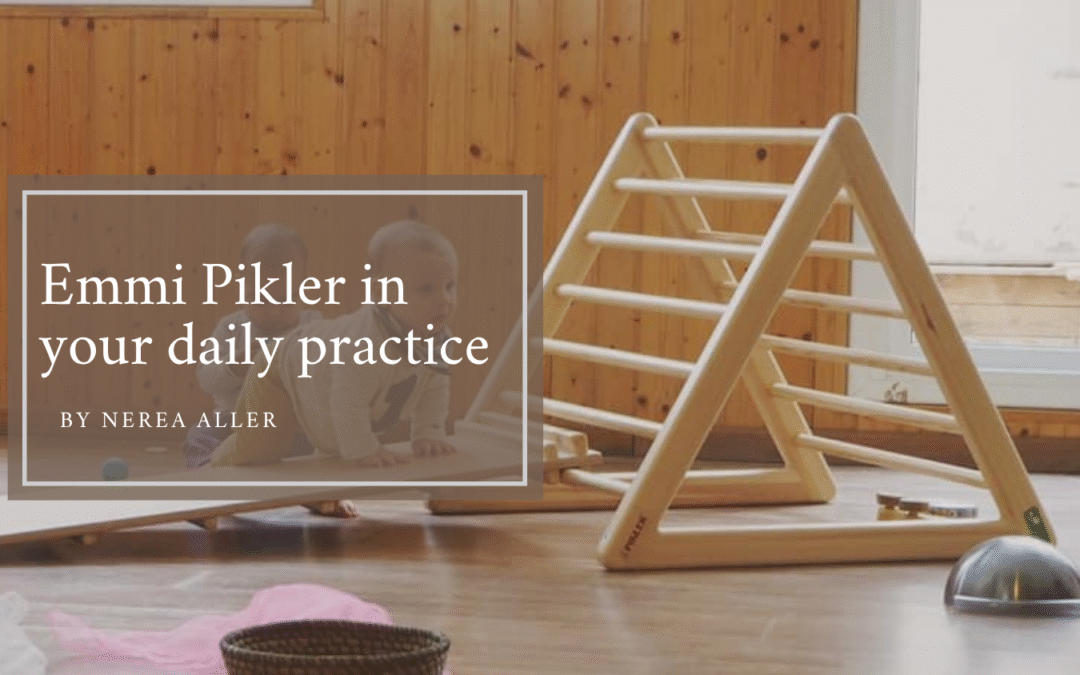
Following the post The Discoveries of Emmi Pikler, I wanted to translate some of her theoretical ideas into practical suggestions. These ideas can be applied both in infant playrooms and at home. I hope they’re helpful for you — and your thoughts and experiences will be invaluable for other readers, so feel free to share them in the comments at the end.
You can also continue reading Play in the First Year of Life: development, environment and resources to explore in more detail the changes that take place during the baby’s first year and how we can accompany these processes respectfully.
Now let’s look at these ideas one by one, focusing on the environment and on our emotional presence.
Ideas in Practice

At this point you might still be wondering: How do I bring all of this into my daily life?
Every situation and every child is unique. Still, I’ll share what I’ve learned through my own experience and through training with educators from the Lóczy Institute.
We’ll look at two main aspects of practice:
- Preparing the environment
- Preparing yourself emotionally
1. Preparing the environment
Here are some strategies to create a space that respects the principles mentioned earlier:
Set coherent goals
Use materials and movement structures that babies can explore independently, without relying on constant adult help. Avoid goals that are too difficult and lead to frustration, or too easy and quickly become boring.
For example, once babies are crawling, you can offer wooden climbing structures (like a Pikler triangle or a small ladder) that they can access on their own — but avoid equipment where adult support is always needed, such as tall slides.
Choose stable materials
Opt for materials that offer firmness and stability, such as wood. In nature, the surfaces we step on are solid; this helps babies learn to stand and balance. For this reason, avoid mattresses and soft pads during the early years.
Support autonomous movement
Adapt the environment so babies can reach spaces and objects by themselves:
• low beds and washbasins
• changing tables with steps
• removing hazards like exposed sockets, slippery areas or sharp edges
A safe, clean space allows them to move freely and allows you to stay calm.
Respect their interests
Notice what they choose repeatedly: throwing, climbing, filling and emptying, pushing… These are their ways of asking for specific types of exploration. Instead of discouraging these actions because they feel inconvenient, find a time and space where they can explore them safely.
Use rich, open-ended materials
By “rich” I mean materials that offer multiple possibilities:
• versatile furniture (for example, a large wooden box that can store objects, become a step, or be turned over to climb on)
• modules and crates to create different heights
• open-ended objects: wooden blocks, rings, baskets, scarves, containers
There’s no need to constantly replace materials. If they are open-ended and freely accessible, children can reinvent their use over and over.

Here are some materials you can build or buy for home or early years settings (some designed at the Lóczy Institute, others widely used for similar purposes):
- Large rocker
- Pikler ball
- Triangle and ramp
- Stackable boxes
- Climbing arch
- Crawling box
- Learning tower and multifunctional table
- Pikler labyrinth
- Three-position chair
- Pikler changing table
2. Preparing yourself emotionally
You can make many changes to the environment, but without the right attitude, they won’t have the impact you hope for.
Trusting that babies learn naturally — including how to move and how to play — transforms the way we accompany them.
Here are some shifts to consider:
Don’t fear falls
If the space is well prepared and developmentally appropriate, babies will move safely. Minor falls may still happen, and that’s part of the learning process. Falling is how they learn to get up.
When facing a new challenge, like climbing stairs for the first time, stay close — but remember that trusting them helps them trust themselves.
Redefine what “helping” means
Helping doesn’t mean showing how to do it. It means giving the child time and space to find their own way. If we show our method, we create dependence; if we step back, we support autonomy.
You can express this trust in your own words, for example:
“I saw how much you tried today. You’ll get there in your own time.”
“I see you want to do it that way. That’s okay — it’s your way.”
Speak with consideration
Before children speak in sentences, communication can be challenging and frustration may arise. Even if they don’t talk yet, they understand your tone, expression and emotional presence.
By describing what is happening or acknowledging what you think they might be feeling, you help them organise their inner world and feel understood.
Avoid rushing
Our adult pace rarely matches a baby’s pace. Committing to slow, attentive moments — like observing their play or changing a nappy — can be difficult but possible with intention.
Reflecting on your habits and reorganising your priorities creates the time they need.
Observe with presence
Your main role is to prepare a rich environment and offer a stable, attentive presence.
Seeing the child as capable requires sustained observation and non-interference.
At first, stepping back from play may feel like “not doing anything”, but there is so much to see: gestures, tiny changes, peer relationships, frustration, engagement, satisfaction…
Documenting what you see — in writing or pictures — helps you notice progress and adjust the environment to new capacities.
Observation is an act of humility and respect: a willingness to discover who the child is and what they need.
Handle With Gentleness
Gentleness goes hand in hand with unhurried time, calm gestures, and conscious touch. In her article The Educator’s Hand, Anna Tardos reminds us that a hand can express as much as a face. For a child, it’s not only what we say but how we touch them, how we approach them, and how we are present.
Getting down to their level, pausing to observe how they feel, and responding softly to what they need in that moment are already acts of deep respect. Gentleness is not a technique; it’s an attitude.
Let’s talk for real…
It’s common to think “this is impossible with 20 children” or “at home I don’t have the time to do this every day”. And that’s completely understandable. Pikler’s ideas were born in very specific contexts and can sometimes feel far from our daily reality.
Even so, small changes are possible. It’s not about doing everything perfectly, but about slowly transforming the way you see children. Pikler worked with highly trained teams and unique settings, yet today these principles are being adapted to both families and real classrooms. This shift takes time. It asks us to revisit our beliefs, our own childhood experiences, and our relationship with the body, play, and infancy.
No theory fits every context exactly. The key is to take what resonates, adapt it to your culture and conditions, and put it into practice as much as you realistically can. Still, the contributions of Emmi Pikler and the work of the Lóczy Institute remain groundbreaking, inviting us to ensure stable relationships, safe environments, and truly playful spaces where babies can grow with balance.