
If you’re reading this, you’re likely hoping to understand a bit more about how children learn through play —whether your own child, your students, or out of personal interest. I’d love to share a few insights into the development of play during that critical first year of life.
One of the books that has most helped me grasp the beginnings of play in infants and the support they need from their environment is The Origins of Free Play by Éva Kálló and Györgyi Balog. Unfortunately, it’s not available in stores and can only be found on the official website of the Emmi Pikler Institute.
But to ensure you don’t miss out, I’ll summarize a few key ideas from the book along with my own thoughts on:
- The natural development of play in the first year of life
- Setting up a space that supports independent and safe play
Let’s dive in!
What will you find in this post?
1. Play during the first year of life
To understand a infant’s play during the first year of life, it’s essential to closely observe the movements and changes they experience. This requires many moments of observation and reflection. Thankfully, there are studies that help us better understand these learning processes, such as those conducted at the Lóczy Institute by pediatrician Emmi Pikler. You can delve deeper into this in the post Emmi Pikler and How to Transform Your Own Practice.
When it comes to play, observing a baby reveals patterns that emerge throughout this first year (I won’t specify ages here, as these can vary and depend on each child’s unique development).
Below, I’ll highlight the progression of actions a child typically follows, along with some materials you can offer to support this natural process.
- Discovering Hands: When the newborn doesn’t have an adult nearby, they often start entertaining themselves by watching their hands, playing with them, and preparing for later object manipulation. This discovery of their hands marks the earliest sign of play. It’s important to let babies explore their hands without immediately distracting them with toys or hanging rattles in their crib. At this stage, their primary “toy” is their own hand.
- First Play Objects: After this discovery of their hands, babies begin to show interest in nearby objects. This is the time to introduce their first playthings. One of the most common objects used at the Lóczy Institute is a vibrant cotton cloth with high-contrast colors (like black or red with white polka dots) that can easily attract their attention and be held with ease.
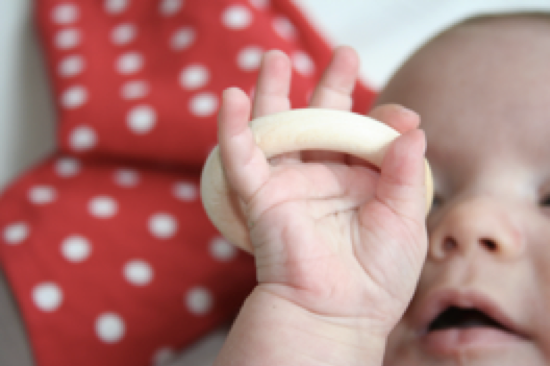
- Manipulation: Soon, babies start reaching for objects nearby with one hand and experimenting with different ways to manipulate them. This is the time to offer items that can be held fully or partially with one hand, like teething rings or rubber toys without any internal sound.
- Dropping Objects: Babies start reaching for objects a bit further from the crib, stretching to grab them or even scooting toward them. They may also start dropping objects to observe the effects. They’re exploring “drop and pick up” and “lost and found,” as described by the authors of the book. At this stage, objects like a wicker ball or a soft pin toy are ideal. It’s best if these toys don’t roll too far, like rubber balls, so babies can retrieve them with ease.
- Exploring Qualities: By now, babies may be scooting around to reach for more distant objects and studying their qualities—whether they’re big, tall, unstable, delicate, circular and roll, or have cavities. They might enjoy accessible items like wooden or metal bowls, baskets, or wooden cups. You could also offer wooden eggs or a treasure basket but place these objects directly on the floor to support the baby’s movement (you’ll find more detail in the play guide).
- Relating Objects: Once babies can hold a small object in each hand, they may start banging them together (e.g., honey dippers or rings) or dropping one item into another (e.g., placing wooden blocks or natural items into bowls or baskets).
After exploring the qualities of objects, the child begins to investigate what else they can do with them. It’s no longer just about sound, smell, taste, touch, or color—now, relationships between objects come into play (logical-mathematical exploration, or logical relationships, if we use formal terms). The child might place multiple objects into a container, tip them out, regroup, and compare them. The same containers and objects they previously used for simple exploration now become tools for sorting and collecting.
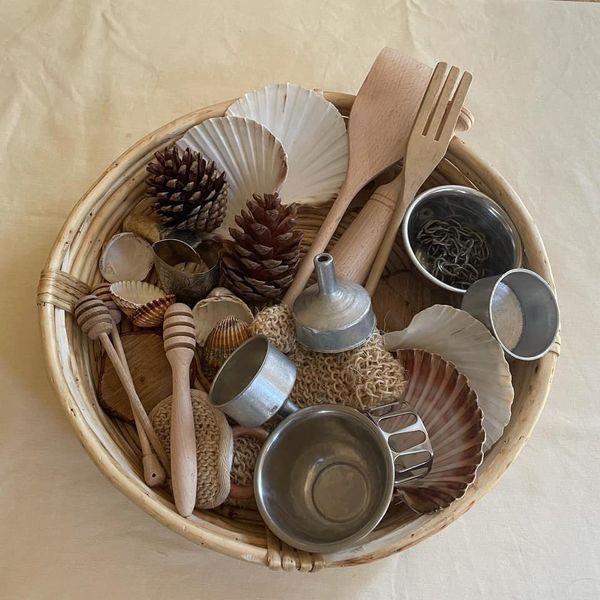
As you can see, large toys or even traditionally designed toys are not necessary, simple, everyday objects can be more interesting.
As you can see, large toys or even traditionally designed toys are not necessary, simple, everyday objects can be used.
2. How to prepare the play environment?
- Limited Space: Whether at home or in a shared play area, it’s usually recommended to separate children who are walking or crawling from those who are still lying down. This way, each child feels safer and can explore without interference. At the Lóczy Institute, wooden-barred partitions were used to separate the play areas for non-crawling babies from the rest of the room. Of course, you don’t have to divide it in the same way; the key is to provide a calm and secure space where babies can move freely and still see the adult nearby.
- Adapting to Their Position: In the beginning, babies explore while lying on their backs. Objects should be placed within reach but at a distance that presents a bit of a challenge, encouraging movement without being so far that the baby cannot reach them independently.
- Surface: A soft surface isn’t recommended, as it doesn’t support balance and stability in a child’s movements. It can also distort the natural effects of objects. For example, hitting a metal object on a cushioned floor dampens the sound, and a rolling object stops more quickly. At Lóczy, they used taut sheets to insulate against cold floors.
- Choosing Objects: Observing these play moments is essential to understand the actions the child is engaging in and to select objects that best complement these actions. For example, if the child:
- presses with their hands, offer fabric or rubber objects;
- hits one object against another, provide metal or wooden objects;
- throws objects, give items of different materials so they can observe different effects.
The choice of objects should primarily reflect the actions the child is exploring. Place a variety of objects within easy reach, especially if they can’t yet turn to reach further ones. Replace items they lose interest in with something new, but avoid changing all objects at once or too frequently. As Kálló & Balog explain, “If their toys change too often, their play can become superficial” (p. 29).
- Adult’s Role: More than the objects themselves, the adult’s approach to the infanrt’s exploration is most important: how they observe, create a safe space for movement, and recognize the child’s own learning capacity is essential. You can read more about this in the post on Emmi Pikler and free movement.
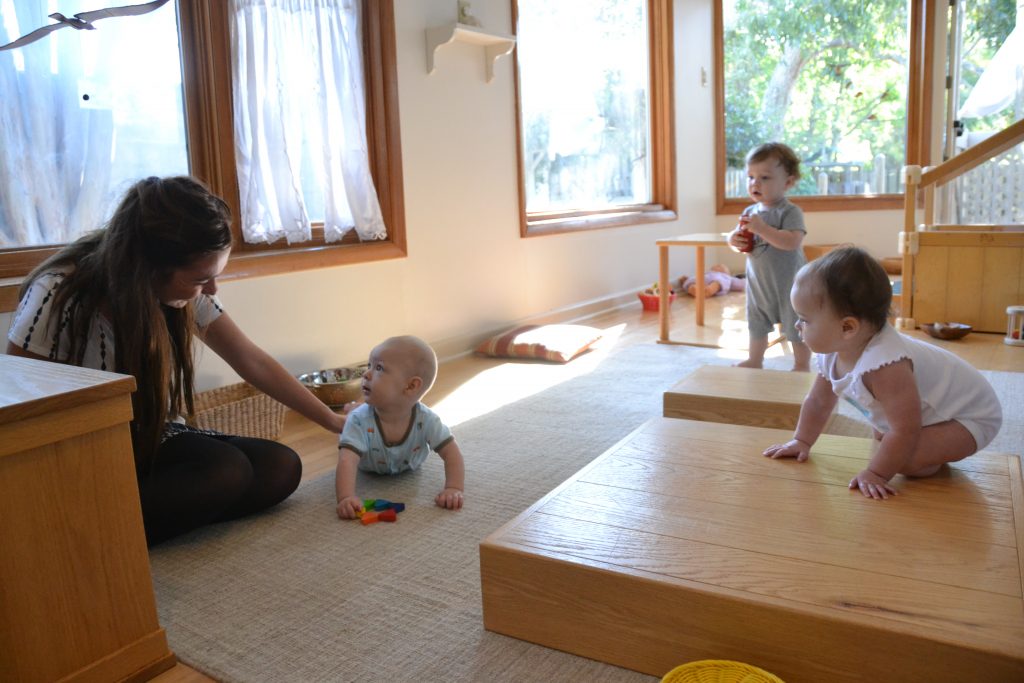
The most important aspect isn’t the objects themselves but rather the adult’s approach to the baby’s exploration: how they observe the child, arrange a safe space for free movement, and acknowledge the baby’s own capacity for learning.
I hope this post has been useful and I look forward to your comments below.
What have you discovered by observing children’s play? What other recommendations would you give to adapt the play space for the first year of life?
If this post has helped you, don’t forget to share on your social networks or download your FREE PLAY GUIDE. Spread the love and lead with your heart!